
Cell-to-cell context
Identify the populations, boundaries, distances and signals that may influence differentiation or development.
Application pathway: stem cell models
Stem cell and developmental models can depend on neighbouring populations, matrix context, gradients and change over time. JetBio starts with those interactions, then assesses the deposition route and workflow.
Model design
Spatial organisation is useful only when it supports a biological hypothesis. A development brief should explain which cells and materials must be positioned, what changes over time and how those changes will be measured.
Identify the populations, boundaries, distances and signals that may influence differentiation or development.
Define the hydrogel, substrate, structural support and crosslinking conditions required by the cells.
Set sampling points and readouts for morphology, identity, organisation or function over time.
Modular process development
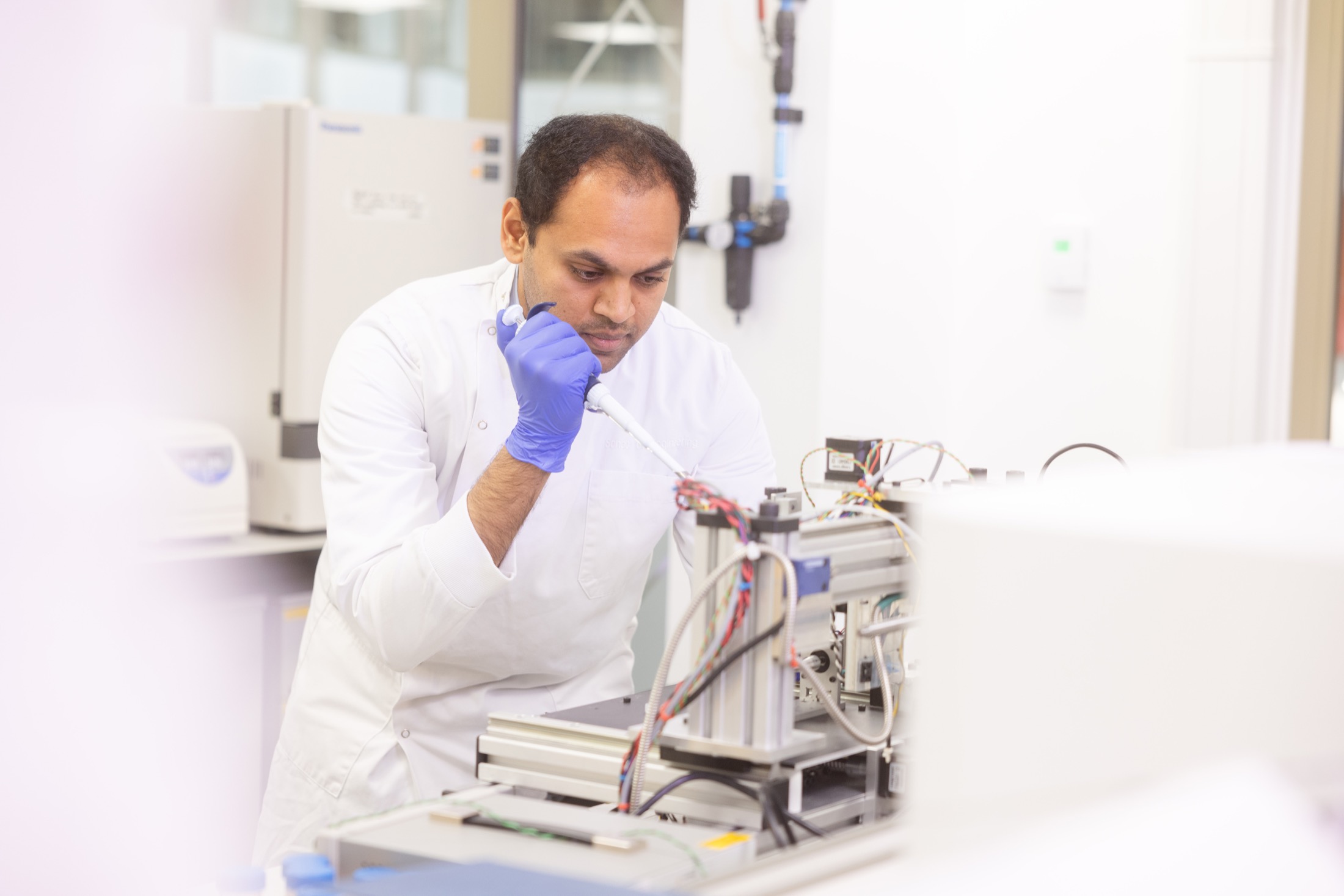
ReJI, microvalve and inkjet development modes provide different ways to form gels and place droplets or patterns. The best route depends on the intended structure, material behaviour, cell sensitivity, culture workflow and readout.
Feasibility questions
Define the differentiation, self-organisation, migration or maturation process under study.
Record cell source, identity, passage, preparation, density and relevant quality measures.
Separate essential placement or geometry from complexity that does not change the experiment.
Plan controls, replicate numbers, time points and measures of biological and process consistency.
Research context
The Cambridge Stem Cell Institute describes a MiniREJI research system funded through the NC3Rs 3D-IV programme. Newcastle University also hosts a ReJI dataset involving intestinal stem cells derived from pre-term infant gut organoids. These are research-use signals, not commercial or clinical validation.
Cambridge Stem Cell Institute facility pageJetBio does not present this pathway as a clinical, therapeutic or implantable-tissue offer. Current positioning is for research and model development.
Related journeys
Review platform fit, evidence, feasibility and the information needed for a useful first discussion.
Follow the researcher journeyDefine the model's decision context, performance requirements and route towards repeatable use.
Follow the drug-discovery journeyStart a useful conversation
Share the cells, material context, spatial relationship, culture process and readout. JetBio will assess the most credible route.